



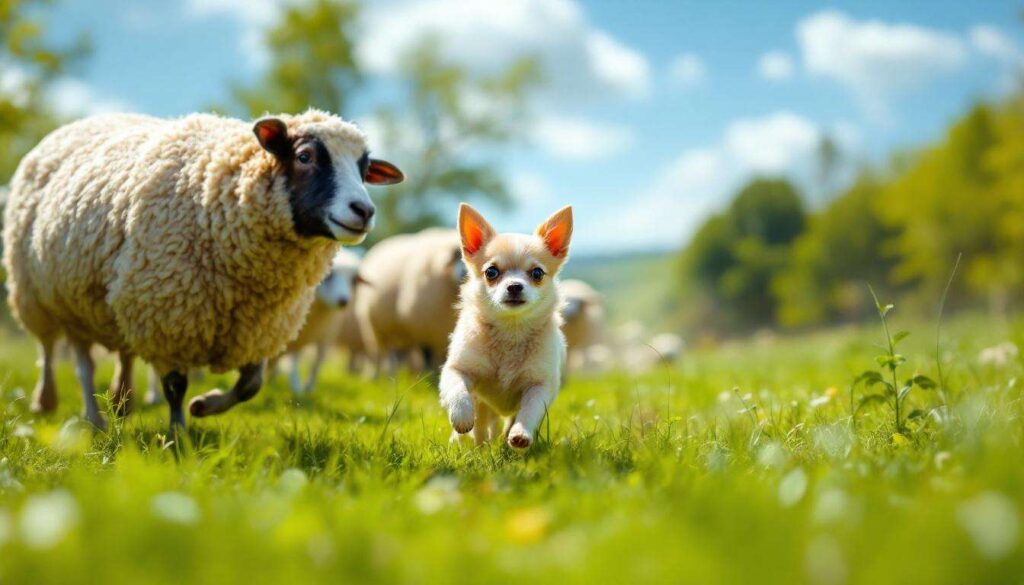
The image of a Chihuahua herding livestock might seem absurd at first glance. These tiny dogs, weighing barely more than a bag of sugar, are typically associated with handbags and lap-sitting rather than the rugged work of managing sheep or cattle. Yet the question persists amongst dog enthusiasts and herding communities: could these diminutive canines possess hidden talents that challenge our preconceptions ? Exploring this unlikely scenario reveals fascinating insights into breed characteristics, instinctual behaviours, and the limits of canine versatility in working roles.
The characteristics of the Chihuahua: an unusual profile for herding
Physical attributes that set Chihuahuas apart
The Chihuahua stands as one of the smallest dog breeds recognised worldwide, typically weighing between 1.8 and 2.7 kilograms. Their compact frame, measuring just 15 to 23 centimetres in height, presents an immediate contrast to traditional herding breeds. Border Collies, Australian Shepherds, and German Shepherds all possess substantially larger builds designed for endurance and physical presence amongst livestock.
| Breed | Average Weight (kg) | Average Height (cm) |
|---|---|---|
| Chihuahua | 1.8-2.7 | 15-23 |
| Border Collie | 14-20 | 46-56 |
| Australian Shepherd | 16-32 | 46-58 |
Temperament and personality traits
Chihuahuas exhibit distinctive personality characteristics that differ markedly from conventional herding dogs. These include:
- Strong attachment to individual owners rather than independent working drive
- Tendency towards territorial behaviour and suspicion of strangers
- High-pitched vocalisation that lacks the commanding authority of larger breeds
- Preference for comfort and warmth over outdoor endurance activities
Despite these seemingly unsuitable traits, Chihuahuas demonstrate remarkable courage and tenacity that occasionally surprises observers. Their fearless nature often leads them to confront animals many times their size, though this bravado stems from protective instincts rather than herding drive.
Understanding these fundamental characteristics provides essential context for evaluating whether natural instincts might compensate for physical limitations.
The natural herding instinct: what role for a Chihuahua ?
The genetic foundations of herding behaviour
Herding instinct represents a modified form of predatory behaviour that has been selectively bred into certain dog lineages over centuries. Traditional herding breeds possess genetic programming that drives them to gather, control, and move livestock through specific behavioural patterns including eye contact, stalking postures, and strategic positioning.
The Chihuahua’s ancestry traces back to ancient Mexico, where these dogs served primarily as companions, spiritual symbols, and potentially food sources rather than working animals. Their genetic heritage contains no deliberate selection for livestock management abilities, creating a fundamental absence of the instinctual framework that herding requires.
Behavioural observations in Chihuahuas
When observing Chihuahuas in environments with other animals, several behavioural patterns emerge:
- Chasing behaviour typically stems from prey drive rather than controlled herding instinct
- Lack of the characteristic “eye” that Border Collies use to control livestock
- Inability to maintain sustained focus on group dynamics of multiple animals
- Tendency to become overwhelmed or reactive rather than methodical in approach
The absence of natural herding instinct presents perhaps the most significant barrier to Chihuahua herding capability. Whilst training can modify behaviour, it cannot create fundamental instinctual drives that simply do not exist within a breed’s genetic makeup.
Beyond instinct, the question of whether Chihuahuas possess the cognitive capacity to learn herding tasks deserves examination.
The learning abilities of the Chihuahua compared to traditional breeds
Intelligence and trainability metrics
Canine intelligence researcher Stanley Coren ranked Chihuahuas as possessing fair working and obedience intelligence, placing them in the lower-middle range of trainability amongst recognised breeds. Border Collies, conversely, consistently rank as the most intelligent and trainable dogs, responding to new commands within five repetitions and obeying on the first command 95% of the time.
Chihuahuas typically require 40 to 80 repetitions to learn new commands and respond to first commands approximately 30% of the time. This disparity suggests significant challenges in teaching complex herding sequences that demand immediate responsiveness and nuanced understanding of handler signals.
Problem-solving and adaptability
Effective herding dogs must demonstrate:
- Independent decision-making when working at distance from handlers
- Ability to read and respond to livestock behaviour patterns
- Spatial awareness to position themselves strategically
- Stamina to maintain concentration during extended working periods
Chihuahuas show limited capacity for independent problem-solving in working contexts, preferring instead to seek guidance from their owners. Their attention spans prove shorter than traditional herding breeds, and they demonstrate less inherent understanding of spatial relationships required for effective livestock management.
However, these cognitive limitations must be weighed against the breed’s physical capabilities and constraints.
The physical advantages and disadvantages of the Chihuahua for herding training
Significant physical limitations
The Chihuahua’s diminutive size creates multiple practical obstacles for herding work:
- Insufficient physical presence to command respect from livestock, particularly cattle or large sheep
- Vulnerability to injury from kicks, trampling, or aggressive defensive behaviour from animals
- Limited stamina for covering the extensive distances required in pasture work
- Inability to withstand harsh weather conditions that herding dogs routinely face
- Lack of vocal authority, with their high-pitched barking failing to influence livestock movement
A single defensive kick from a sheep could prove fatal to a Chihuahua, whereas breeds like Australian Cattle Dogs possess the size and agility to avoid such dangers whilst maintaining their working position.
Potential advantages in specific scenarios
Despite overwhelming disadvantages, certain theoretical advantages exist in highly specific circumstances:
| Advantage | Potential Application |
|---|---|
| Small size | Working with miniature livestock breeds or poultry |
| Agility | Navigating confined spaces larger dogs cannot access |
| Energy | Short bursts of intense activity in limited areas |
These advantages remain largely theoretical, as practical implementation faces numerous challenges that outweigh potential benefits in nearly all realistic herding scenarios.
Yet some owners have attempted to defy these limitations, producing surprising results worth examining.
Case studies: chihuahuas that defy stereotypes
Documented instances of Chihuahuas with livestock
Whilst comprehensive studies remain scarce, anecdotal evidence suggests isolated cases where Chihuahuas have demonstrated unexpected behaviours around livestock. Social media platforms occasionally feature videos of Chihuahuas interacting with chickens, ducks, or small goats, though these interactions typically represent playful engagement rather than genuine herding work.
One notable case involved a Chihuahua named Pixel who reportedly assisted in moving small groups of bantam chickens on a hobby farm. The owner described the dog’s behaviour as “enthusiastic chasing that occasionally resulted in the chickens moving in the desired direction”, though this hardly constitutes the controlled, purposeful herding demonstrated by working breeds.
The reality behind viral videos
Internet content featuring Chihuahuas “herding” often reveals significant differences from authentic herding work:
- Edited footage that excludes unsuccessful attempts or chaotic outcomes
- Livestock already trained to move in specific patterns regardless of dog presence
- Short duration clips that do not demonstrate sustained working ability
- Human intervention occurring off-camera to guide both dog and animals
Professional herding trainers who have reviewed such content consistently note that the behaviours displayed lack the fundamental elements of genuine herding, including controlled movement, strategic positioning, and responsive communication between handler and dog.
These observations raise important questions about whether pursuing Chihuahua herding represents a viable future direction or merely an entertaining novelty.
The future of Chihuahuas in herding: myth or reality ?
Practical considerations for working environments
The agricultural and pastoral industries require reliable, efficient, and safe working dogs that can perform demanding tasks across varied conditions. Chihuahuas fail to meet these fundamental requirements in virtually every measurable category. Their physical vulnerability alone creates unacceptable risk in professional settings where livestock welfare and worker safety remain paramount concerns.
Furthermore, the economics of herding operations demand dogs capable of managing large numbers of animals across extensive areas, tasks for which Chihuahuas possess neither the physical capacity nor the instinctual programming.
Alternative roles and realistic expectations
Rather than pursuing herding capabilities, Chihuahua owners might consider roles better suited to the breed’s natural strengths:
- Companion animals providing emotional support and companionship
- Alert dogs using their vocal nature to signal visitors or unusual activity
- Therapy dogs in settings requiring small, portable animals
- Competitive obedience or agility at levels appropriate to their size
Attempting to force Chihuahuas into herding roles represents a misunderstanding of both breed purpose and animal welfare. Each breed possesses characteristics developed for specific functions, and respecting these inherent traits ensures dogs lead fulfilling lives aligned with their natural capabilities.
The notion of Chihuahua herding dogs remains firmly in the realm of novelty rather than practical reality. Centuries of selective breeding have created profound differences between toy companion breeds and working livestock dogs that cannot be overcome through training alone. Whilst individual Chihuahuas may display amusing interactions with smaller animals, these behaviours lack the complexity, control, and reliability that define genuine herding work. The physical dangers, limited instinctual drive, and inadequate size make Chihuahuas fundamentally unsuitable for livestock management. Rather than pursuing inappropriate roles, owners serve their Chihuahuas best by celebrating the qualities that make these dogs exceptional companions, acknowledging that not every breed can or should perform every task.