



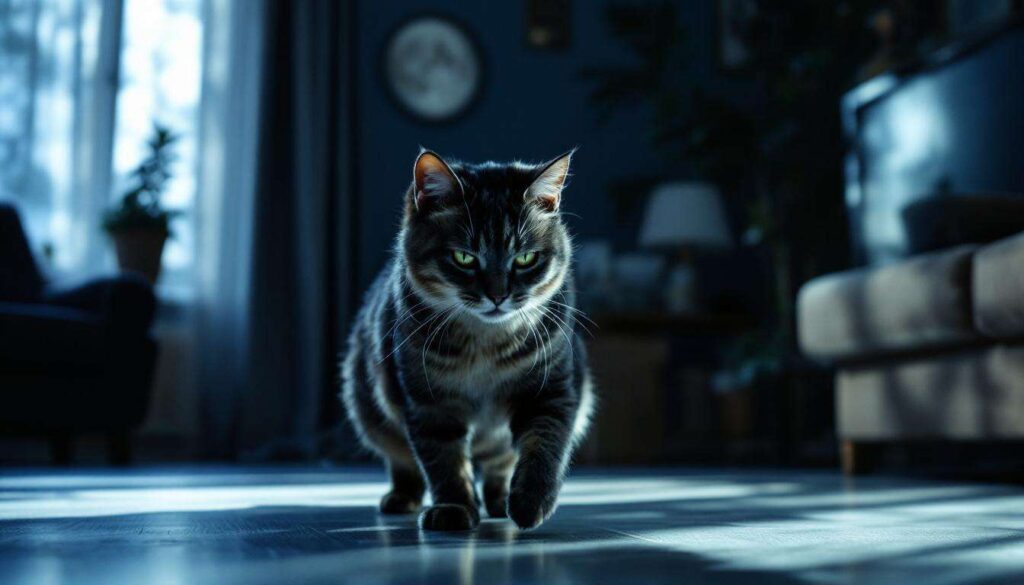
Cats spend much of their lives asleep, often curled up in the most unexpected places. Their ability to drift into slumber at any moment has long fascinated pet owners and researchers alike. Yet amidst the twitching paws and gentle purring, a peculiar question emerges: can cats actually sleepwalk ? This phenomenon, well-documented in humans, remains shrouded in mystery when it comes to our feline companions. Understanding whether cats experience genuine sleepwalking requires a closer examination of their unique sleep patterns and behaviours.
Introduction au phénomène du somnambulisme chez les chats
What is sleepwalking ?
Sleepwalking, medically known as somnambulism, occurs when an individual performs complex behaviours whilst remaining in a state of sleep. In humans, this condition typically manifests during deep non-REM sleep stages, where the brain remains partially active whilst consciousness is absent. The sleepwalker may walk, talk, or perform routine activities without any recollection upon waking.
The rarity of feline sleepwalking
Whilst sleepwalking is relatively common in humans, particularly children, documented cases in cats are exceptionally rare. Veterinary literature contains minimal evidence of true somnambulism in felines, with most reported instances linked to specific neurological conditions or brain injuries. The question remains whether what appears to be sleepwalking is actually something entirely different.
Distinguishing dreams from sleepwalking
Many cat owners have observed their pets twitching, moving their paws, or making small vocalisations during sleep. These movements often lead to speculation about sleepwalking, but experts suggest they are more likely dream-related reflexes rather than genuine somnambulistic episodes. The distinction between active dreaming and true sleepwalking becomes crucial in understanding feline sleep behaviour.
To properly assess whether cats can sleepwalk, one must first understand the intricate architecture of their sleep cycles and how these differ from human patterns.
Comprendre le cycle de sommeil félin
The remarkable sleep duration of cats
Cats are champion sleepers, spending approximately 16 to 18 hours per day in slumber. This represents roughly 70% of their entire lives spent sleeping. This extraordinary sleep requirement stems from their evolutionary heritage as predators, where conserving energy between hunting opportunities proved essential for survival.
| Sleep phase | Duration | Characteristics |
|---|---|---|
| Light sleep | 15-30 minutes | Easily awakened, senses remain alert |
| Deep sleep | 5-7 minutes | Complete relaxation, reduced awareness |
| REM sleep | 5-7 minutes | Dreaming occurs, rapid eye movement |
The two main sleep stages
Feline sleep consists of two primary phases: slow-wave sleep (non-REM) and rapid eye movement sleep (REM). During slow-wave sleep, cats maintain a degree of alertness, with their senses remaining approximately 70% active. This allows them to respond swiftly to potential threats or opportunities. REM sleep, conversely, is when dreaming occurs and the body experiences temporary muscle paralysis to prevent physical enactment of dreams.
The dreaming brain
Research suggests that the hippocampus, the brain region responsible for memory processing, functions similarly across mammalian species. This indicates that cats, like humans, likely dream about their daily experiences:
- Chasing prey or toys
- Interacting with other cats or humans
- Exploring familiar territories
- Repeating learned behaviours
These dream experiences may explain the physical movements observed during sleep, but they do not necessarily constitute sleepwalking. The comparison with human sleep patterns reveals important distinctions that further illuminate this question.
Les différences entre le sommeil humain et le sommeil félin
Sleep cycle length variations
Human sleep cycles typically last 90 to 110 minutes, with individuals progressing through multiple cycles each night. Cats, however, experience much shorter cycles, often completing the transition from light sleep to REM sleep in approximately 20 to 30 minutes. This rapid cycling means cats enter and exit deep sleep states far more frequently than humans.
Alertness during rest
One of the most significant differences lies in the level of environmental awareness maintained during sleep. Humans typically disconnect from their surroundings during deep sleep stages, whereas cats retain a remarkable degree of sensory vigilance throughout much of their rest period. This evolutionary adaptation allows them to remain responsive to potential dangers even whilst sleeping.
Muscle control mechanisms
During human REM sleep, the body experiences muscle atonia, a temporary paralysis that prevents physical enactment of dreams. This protective mechanism occasionally fails in sleepwalkers, allowing movement whilst consciousness remains suppressed. In cats, this paralysis also occurs during REM sleep, but their lighter sleep phases permit greater mobility without constituting true sleepwalking.
| Feature | Humans | Cats |
|---|---|---|
| Daily sleep duration | 7-9 hours | 16-18 hours |
| Sleep cycle length | 90-110 minutes | 20-30 minutes |
| Sensory awareness during sleep | Minimal | Approximately 70% |
| Sleepwalking prevalence | 2-4% of adults | Extremely rare |
Understanding these fundamental differences helps explain why genuine sleepwalking appears so uncommon in cats, but recognising the signs of unusual sleep behaviour remains important for concerned pet owners.
Signes distinctifs d’un chat somnambule
Normal sleep movements versus abnormal behaviour
Most movements during feline sleep are entirely normal and relate to dreaming. However, certain behaviours may indicate something more concerning. Normal sleep activity includes:
- Twitching whiskers or ears
- Gentle paw movements
- Soft vocalisations or purring
- Minor body adjustments
- Rapid eye movement beneath closed lids
Potential indicators of sleepwalking
True sleepwalking in cats, though rare, might manifest as complex, coordinated movements performed whilst the animal remains unconscious. Possible signs include:
- Walking with a glazed or unfocused expression
- Performing routine activities without apparent awareness
- Failing to respond to name or stimuli
- Appearing disoriented upon waking
- No memory of nocturnal activities
Associated neurological conditions
The few documented cases of feline sleepwalking have typically been linked to underlying medical issues, particularly neurological conditions or brain trauma. These might include seizure disorders, cognitive dysfunction, or structural brain abnormalities. Such cases require immediate veterinary attention to identify and address the root cause.
Recognising when unusual sleep behaviour warrants professional evaluation becomes essential for maintaining your cat’s health and wellbeing.
Quand consulter un vétérinaire
Warning signs requiring immediate attention
Whilst occasional dream twitches are harmless, certain symptoms demand prompt veterinary consultation. Pet owners should seek professional advice if their cat exhibits:
- Sudden changes in sleep patterns or duration
- Violent or aggressive movements during sleep
- Apparent confusion or disorientation after waking
- Walking or moving with eyes open but unresponsive
- Injuries sustained during sleep episodes
- Accompanying symptoms such as seizures or loss of coordination
Diagnostic approaches
A veterinarian will conduct a thorough examination to determine whether observed behaviours stem from normal dreaming, a sleep disorder, or an underlying medical condition. This may include:
| Diagnostic method | Purpose |
|---|---|
| Physical examination | Assess overall health and neurological function |
| Blood tests | Identify metabolic or hormonal imbalances |
| Neurological assessment | Evaluate brain function and reflexes |
| Imaging studies | Detect structural brain abnormalities |
Treatment options
If an underlying condition is identified, treatment will address the specific cause. This might involve medication for seizure disorders, management of cognitive dysfunction, or supportive care for neurological conditions. In most cases, however, what appears to be sleepwalking proves to be normal dream activity requiring no intervention.
Beyond medical evaluation, creating an optimal sleep environment can significantly enhance your cat’s rest quality and reduce concerning behaviours.
Conseils pour assurer le bien-être de votre chat pendant le sommeil
Creating a safe sleep environment
Providing a secure and comfortable sleeping space helps ensure your cat rests peacefully. Consider these recommendations:
- Offer multiple sleeping locations at various heights
- Ensure beds are away from high-traffic areas
- Maintain comfortable ambient temperature
- Provide soft, washable bedding materials
- Remove potential hazards from sleeping areas
Establishing healthy sleep routines
Cats benefit from predictable daily routines that support natural sleep-wake cycles. Encourage healthy sleep patterns by:
- Engaging in active play sessions before bedtime
- Feeding meals at consistent times
- Providing mental stimulation during waking hours
- Respecting your cat’s need for uninterrupted rest
Monitoring without interference
Whilst observing your cat’s sleep behaviour is important, avoid disturbing them unnecessarily. Cats awakened abruptly from deep sleep may become disoriented or startled. Allow natural wake cycles to occur, intervening only if genuine concern for safety arises.
Environmental enrichment
A mentally and physically stimulated cat typically enjoys better quality sleep. Ensure your feline companion has access to:
- Interactive toys and puzzle feeders
- Scratching posts and climbing structures
- Window perches for environmental observation
- Regular social interaction and play
The evidence suggests that genuine sleepwalking in cats remains an exceptionally rare phenomenon, with most observed movements during sleep representing normal dream activity. Understanding feline sleep architecture reveals that cats maintain greater sensory awareness than humans throughout much of their rest, making true somnambulism unlikely. Whilst twitching paws and soft vocalisations are typical manifestations of dreaming, any concerning or unusual behaviours warrant veterinary evaluation to rule out underlying medical conditions. By creating safe sleep environments and supporting healthy routines, pet owners can ensure their cats enjoy the restorative rest essential for wellbeing. The mystery of feline sleep continues to fascinate, reminding us that these remarkable creatures possess complex inner lives that extend even into their dreams.